Fire alarm system types explained
The main types of fire alarm system — conventional, addressable, wireless, analogue addressable, and aspirating — what each does, where each is used, and how to choose the right type for your premises.
Not all fire alarm systems are the same. The type of system fitted to a building determines how precisely the panel can locate a fire, how the system tolerates faults, how it can be programmed, and what it costs to install and maintain. Choosing the right system type is one of the most consequential decisions in a fire alarm project.
The Main System Types
Under BS 5839-1, fire alarm systems are categorised by category (what they protect) and grade (what type of equipment is used). Within those frameworks, systems are also distinguished by their technical architecture — the way devices communicate with the control panel. This is what people usually mean when they talk about “system types”.
Conventional systems
Conventional Fire Alarm Systems
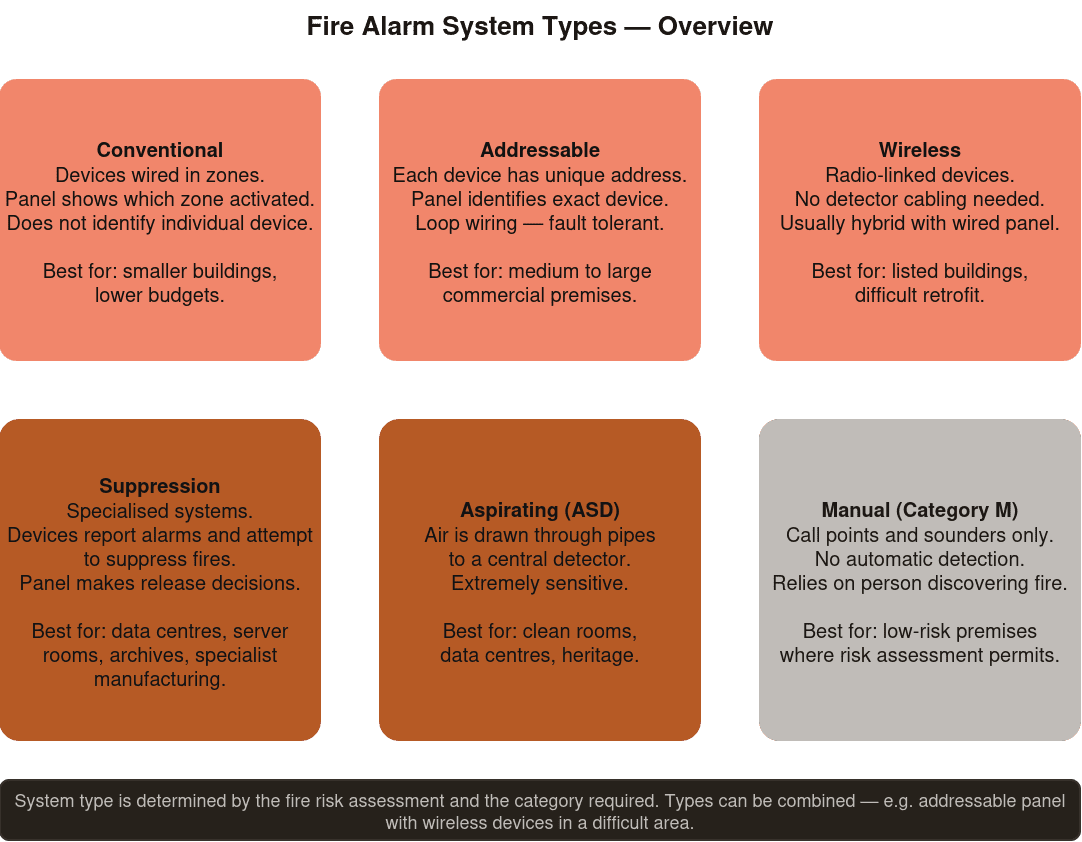
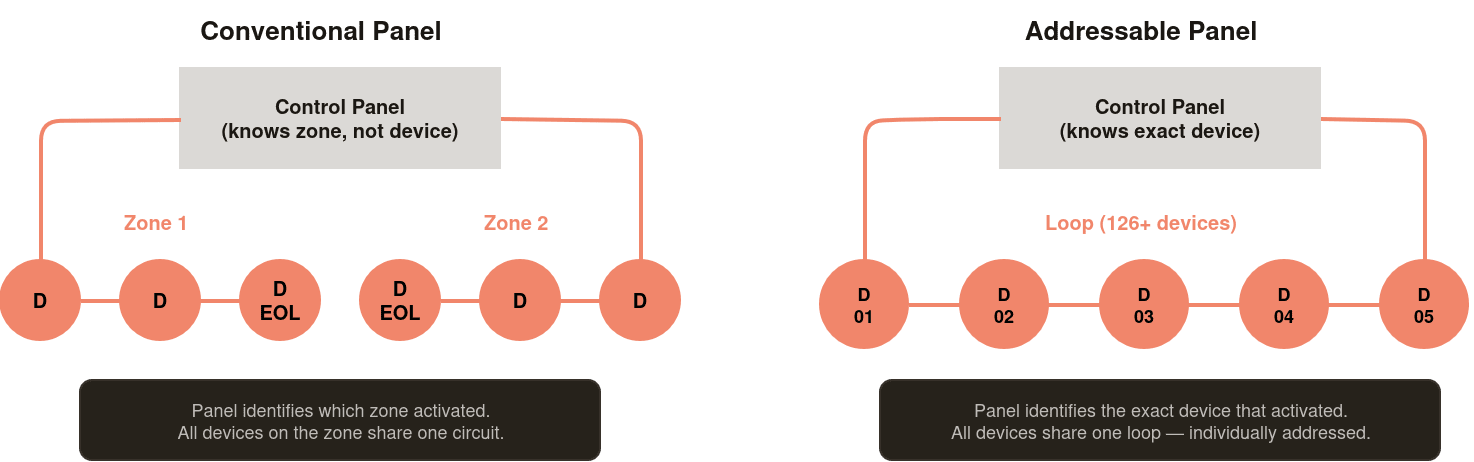
A conventional system divides the building into zones, each served by a wired circuit of detectors and call points. When any device on a zone circuit activates, the panel shows an alarm for that zone — but cannot identify which specific device has triggered.
How the panel identifies the fire: zone level — for example, “Zone 3 — First Floor West Wing”. The responding person must search that entire zone to locate the fire source.
Best for: smaller buildings where the zone areas are small enough to search quickly; budget-sensitive projects; simpler buildings where the additional capability of addressable systems is not needed.
Limitations: cannot identify the specific device; zones must be kept small enough to search quickly (maximum 2,000m² under BS 5839-1); fault location is less precise than addressable systems; programming flexibility is limited.
Addressable systems
Addressable Fire Alarm Systems
Each device on an addressable system has a unique address. The panel communicates with every device individually, polling continuously. When a device activates, the panel displays its exact address and description — “Detector 047 — Server Room, 2nd Floor”. The loop wiring architecture also provides better fault tolerance than conventional radial circuits.
How the panel identifies the fire: exact device — location description displayed immediately.
Best for: medium to large commercial premises; buildings requiring phased evacuation; premises where fast fire location by the fire service is important; any installation with ancillary output programming.
Advantages over conventional: precise fire location; better fault tolerance; flexible cause and effect programming; easier extension and modification; panel event log for fault diagnosis.
Analogue addressable systems
Analogue Addressable Systems
Analogue addressable systems are the most sophisticated type. Standard addressable devices send a binary signal — alarm or normal. Analogue addressable devices send continuous analogue readings of their sensor output — the actual smoke concentration or temperature level, updated continuously.
This gives the panel far more information than a simple alarm/normal signal. The panel can monitor detector sensitivity trends over time (flagging detectors that are gradually contaminating before they false alarm), apply more sophisticated alarm decision algorithms (requiring multiple readings at elevated levels before alarming), and adjust sensitivity thresholds remotely for individual devices.
Best for: large complex buildings; high-risk premises; buildings where false alarm management is critical; installations requiring maximum flexibility in programming and maintenance.
Wireless systems
Wireless Fire Alarm Systems
Wireless systems use radio communication between devices and the panel (or a wireless gateway connected to the panel) instead of wired circuits. The devices themselves — detectors, call points, sounders — run on long-life batteries. The panel is still typically mains-powered with a standby battery.
Wireless systems are not inherently inferior to wired systems — modern wireless technology is highly reliable with supervised two-way communication and tamper detection. Their advantages are in installation rather than performance.
Best for: listed buildings and heritage properties where cable installation would be destructive; retrofit projects where running cables is impractical; temporary installations; buildings where future changes are frequent and rewiring would be disruptive.
Considerations: device battery management is an ongoing maintenance task; radio frequency planning is required in buildings with potential interference sources; range limitations may require repeaters in large buildings. See our dedicated wireless fire alarm guide for more detail.
Aspirating detection
Aspirating Smoke Detection (ASD)
Aspirating systems draw air continuously through a network of sampling pipes to a central, highly sensitive detector unit. Rather than waiting for smoke to drift to a ceiling-mounted detector, the system actively samples the air throughout the protected space.
The sensitivity of an aspirating detector is typically orders of magnitude higher than a conventional point detector — it can detect fire at the very earliest incipient stage, before visible smoke has formed, by sensing the sub-micron combustion particles released by overheating materials.
Best for: data centres, server rooms, and telecommunications facilities where early detection of equipment overheating is critical; clean rooms; heritage buildings with irreplaceable contents; spaces with high airflow where point detectors perform poorly; very high-ceiling spaces where standard detectors would be ineffective.
Choosing the right type
Which System Type Is Right for Your Building?
| Building type | Likely system type | Key reason |
|---|---|---|
| Small office or retail unit (under 500m²) | Conventional | Simple layout; zone areas small enough to search quickly; cost-effective |
| Medium commercial office (500–5,000m²) | Addressable | Precise fire location; cause and effect programming; loop fault tolerance |
| Large complex building or high-rise | Analogue addressable | Maximum programming flexibility; false alarm management; phased evacuation |
| Listed or heritage building | Wireless (hybrid) | Avoids destructive cable installation; preserves historic fabric |
| Data centre or server room | Aspirating (ASD) | Very early detection of equipment overheating; handles high airflow |
| Small low-risk premises | Manual (Category M) | Risk assessment may not require automatic detection |
Common questions
Frequently Asked Questions
Not always — for simple, small buildings an addressable system adds cost and complexity without proportionate benefit. If a conventional system with small, clearly defined zones provides adequate fire location capability for the building’s size and layout, it is a perfectly valid choice. The system type should be matched to the building’s needs. Specifying an addressable system for a 200m² retail unit because “it’s better technology” is poor value engineering. The category and the protection it provides matter more than the system architecture.
Yes — hybrid systems are common. A typical example is a wired addressable system as the main installation with wireless devices used in specific areas where cabling is impractical. The wireless devices connect to the addressable loop via a wireless gateway. Another common hybrid is an addressable main system with conventional zone circuits in simple, low-risk areas of the same building. The panel must support the hybrid configuration, and the cause and effect programme must account for both system types.