Fire alarm system categories explained
A complete guide to BS 5839-1 categories — L1 to L5, P1, P2, and M — what each means, where each applies, and how the category is determined for your premises.
The category of a fire alarm system defines its purpose and the extent of detection coverage required. Getting the category right is one of the most important decisions in fire alarm design — too little protection and you fail to meet the legal standard; too much and you overspend without benefit. The fire risk assessment is the starting point for every category decision.
What Are Fire Alarm System Categories?
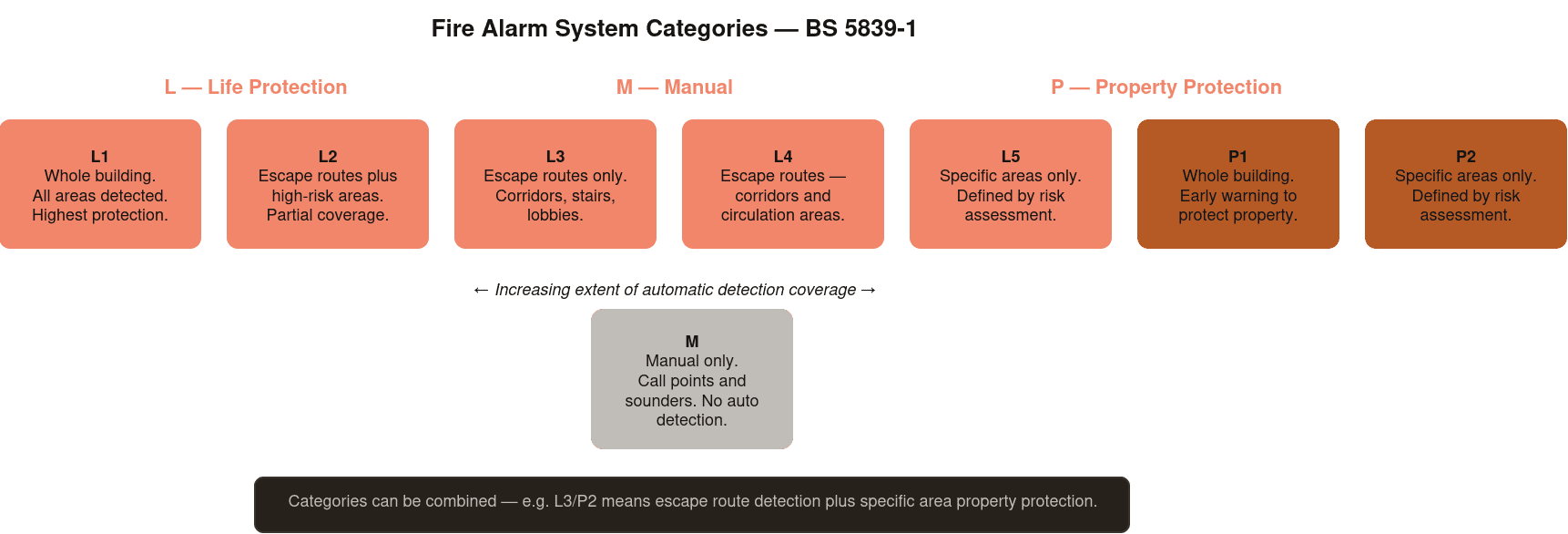
Under BS 5839-1, every fire alarm system is assigned a category that describes its intended purpose and coverage. The category system uses two letters: L for life protection systems, P for property protection systems, and M for manual-only systems.
L categories use automatic detection to protect the lives of occupants. The number after the L indicates the extent of coverage — L1 being the most comprehensive, L5 the most limited. P categories use automatic detection primarily to protect the building and its contents, often by providing early warning to enable a faster fire service response. Category M uses no automatic detection at all.
L categories — life protection
Category L — Life Protection Systems
L category systems use automatic detection to give occupants early warning of fire, enabling safe evacuation. The five L categories differ in how much of the building is covered by automatic detection.
| Category | Coverage | Typical application |
|---|---|---|
| L1 | Automatic detection throughout the entire building — all areas including roof spaces, floor voids, and plant rooms | High-risk premises, large complex buildings, where maximum early warning is required |
| L2 | Escape routes plus defined high-risk areas identified by the fire risk assessment | Commercial premises where specific high-risk areas (kitchens, plant rooms) need detection in addition to escape routes |
| L3 | All escape routes — corridors, stairways, and lobbies — but not rooms off those routes | Premises where early warning on escape routes is the primary objective |
| L4 | Circulation areas forming part of the escape routes — corridors and circulation spaces only | Smaller premises where a limited detection presence on escape routes is sufficient |
| L5 | Specific areas only — defined by the fire risk assessment, not necessarily on escape routes | Where detection is required in one or two specific areas such as a server room or high-value store |
P categories — property protection
Category P — Property Protection Systems
P category systems are designed primarily to protect property rather than lives. They provide early detection to minimise fire damage and enable a prompt fire service response — often via an alarm receiving centre (ARC). P systems are commonly required by insurers for unoccupied premises.
| Category | Coverage | Typical application |
|---|---|---|
| P1 | Automatic detection throughout the entire building | Warehouses, factories, and premises where maximum property protection and early ARC notification is required |
| P2 | Specific areas only — defined by the fire risk assessment | Premises where protection is needed in defined high-value or high-risk areas only |
Category M — manual only
Category M — Manual Systems
Category M systems consist of manual call points and sounders only. There is no automatic detection. The system depends entirely on a person discovering a fire and operating a call point. Category M is appropriate only where the fire risk assessment concludes that automatic detection is not necessary — typically small, simple, single-occupancy premises where all areas are continuously occupied and any fire would be immediately obvious.
The vast majority of commercial premises will require at least a Category L system with some level of automatic detection. Category M alone is never appropriate for premises where people sleep.
Combined categories
Combined Category Systems
Categories can be combined where different parts of a building have different protection requirements. A common combination is L3/P2 — automatic detection on escape routes for life protection, plus detection in a specific high-value area for property protection. The combined category is always written with the L category first.
The Fire Risk Assessment Determines the Category
The category of a fire alarm system is not a choice made by the installer or the building owner in isolation — it is determined by the fire risk assessment. A competent fire risk assessor will identify the nature and extent of detection required based on the occupancy, layout, construction, and use of the building. The system designer then specifies a system that meets that requirement.
Explore each category
Detailed Guides to Each Category
Category L1
Full automatic detection throughout the entire building. The highest level of life protection available under BS 5839-1.
Category L2
Escape routes plus high-risk areas identified by the fire risk assessment.
Category L3
Automatic detection on all escape routes — corridors, stairways, and lobbies.
Category L4
Circulation areas forming escape routes. A more limited form of escape route protection.
Category L5
Specific areas only, defined by the fire risk assessment. The most limited automatic detection category.
Category P1
Full automatic detection throughout the building for property protection and early ARC notification.
Category P2
Specific areas only for property protection — defined by the fire risk assessment.
Category M
Manual call points and sounders only. No automatic detection. Appropriate only for low-risk premises.
L vs P — what’s the difference?
A clear explanation of when an L category, a P category, or a combined system is the right choice.