Category M — manual
fire alarm systems
What a Category M system is, where it is and is not appropriate, and why most commercial premises will need something more — explained by a fire engineer with 30 years of industry experience.
A Category M system relies entirely on people to raise the alarm. There is no automatic detection — only manual call points and sounders. Understanding where this is appropriate, and where it falls short, is essential for anyone making decisions about fire alarm provision.
What is a Category M Fire Alarm System?
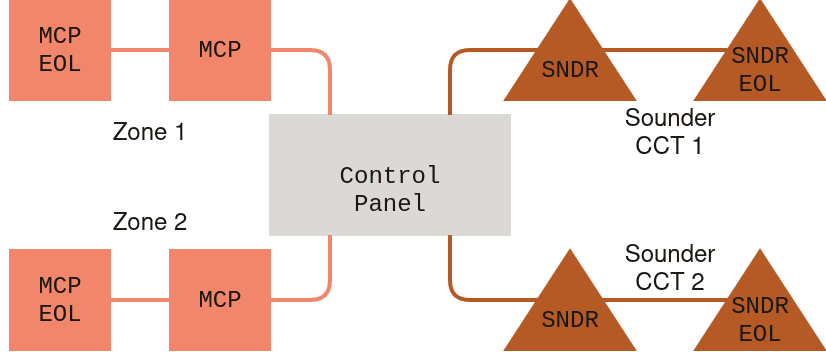
Under BS 5839-1, fire alarm systems are categorised according to their purpose and extent. Category M — where M stands for Manual — is the simplest category. It consists of manual call points (break-glass units) and sounders only. There are no automatic detectors of any kind.
The system depends entirely on a person discovering a fire, walking to a call point, breaking the glass, and triggering the alarm. Once activated, the sounders alert occupants to evacuate. That is the entirety of what a Category M system does.
What the standard says
Category M in BS 5839-1
BS 5839-1 defines Category M as a system intended to provide manual means of raising the alarm only. It does not provide any automatic detection capability and therefore offers no warning of a fire until a person has physically discovered it and operated a call point.
The standard recognises Category M as a legitimate system type, but makes clear that it is only appropriate where the risk assessment concludes that automatic detection is not necessary. In practice, this means premises where:
- All areas are occupied at all times the premises are in use
- Any fire would be immediately obvious to occupants
- The travel distance to a call point is short enough that the alarm can be raised without delay
- The fire risk assessment does not identify a need for automatic detection
BS 5839-1 recommends that manual call points are sited so that no person need travel more than 45 metres to reach one, and that they are positioned on escape routes — typically beside final exit doors and at each storey exit.
System components
What Does a Category M System Consist Of?
| Component | Purpose | Typical requirement |
|---|---|---|
| Manual call points (MCPs) | Allow occupants to manually trigger the alarm on discovery of a fire | Maximum 45m travel distance to nearest MCP; positioned on escape routes |
| Sounders | Alert all occupants to evacuate | Minimum 65 dB(A) at any sleeping position; audible throughout the building |
| Control panel | Receives signal from activated call point and triggers sounder circuits | Positioned where it can be monitored — typically near main entrance |
| Standby power supply | Maintains system operation during mains power failure | Minimum 24 hours standby followed by 30 minutes alarm |
Where it applies
When is Category M Appropriate?
Category M is appropriate in a relatively narrow range of premises. The fire risk assessment is the deciding factor — and in the majority of commercial premises, the assessment will conclude that automatic detection is necessary.
Small, single-occupancy premises
A small workshop, retail unit, or office where all areas are visible and occupied throughout the working day, with a straightforward escape route.
Open-plan spaces with good visibility
Premises where any fire would be immediately visible to all occupants and where travel distance to a call point is short.
Premises with unoccupied areas
Any building with storage areas, plant rooms, or other spaces that are not continuously occupied — a fire in these areas would not be discovered until it had developed significantly.
Premises where people sleep
Hotels, care homes, HMOs, and any premises where people sleep require automatic detection. Category M alone would never be acceptable.
The Fire Risk Assessment is Decisive
Whether Category M is appropriate is not a decision the building owner or facilities manager makes unilaterally. It must be supported by a suitable and sufficient fire risk assessment carried out by a competent person. If that assessment identifies any area that is not continuously occupied, or any scenario where a fire could develop undetected, automatic detection will be required and Category M alone will be insufficient.
Limitations
The Fundamental Limitation of Category M
The critical weakness of a Category M system is the dependency on human discovery. Automatic detection systems can identify a fire within seconds of ignition — sometimes before visible flames or significant smoke have developed. A Category M system offers no such capability.
In any premises where a fire could develop in an unoccupied area, or overnight, or in a location not immediately visible to all occupants, the consequences of relying on manual call points alone could be catastrophic. This is why the vast majority of commercial premises require at least a Category L system with some level of automatic detection.
| Factor | Category M | Automatic detection (Category L or P) |
|---|---|---|
| Detection speed | Dependent on human discovery — potentially minutes or longer | Seconds to minutes from ignition depending on detector type and location |
| Unoccupied areas | No protection — fire undetected until discovered | Detectors active regardless of occupancy |
| Out of hours | No protection when premises are unoccupied | Full protection 24 hours — can be linked to ARC monitoring |
| Insurance implications | Insurers may impose conditions or higher premiums | Generally meets insurer requirements for standard commercial premises |
Installation & maintenance
Installing and Maintaining a Category M System
Despite being the simplest category, a Category M system must still be designed, installed, and maintained in accordance with BS 5839-1. This means installation by a competent person, a commissioning certificate on completion, six-monthly servicing by a competent contractor, weekly manual call point tests by a nominated member of staff, and a fire alarm log book maintained on the premises.
The simplicity of the system does not reduce the maintenance obligation. A manual call point that fails to trigger the alarm on operation — because of a wiring fault, flat battery, or corroded contact — provides no protection at all. Regular testing and servicing are as important for a Category M system as for any other category.
Common questions
Frequently Asked Questions
Yes — but only where the fire risk assessment concludes that manual means of raising the alarm are sufficient. The RRO requires an appropriate means of detecting fire and warning occupants, and for some low-risk premises a Category M system will meet that requirement. For the majority of commercial premises, however, the risk assessment will require automatic detection and a Category M system alone will not be sufficient to comply.
BS 5839-1 recommends that no person should need to travel more than 45 metres to reach a manual call point. Call points should be positioned on escape routes — typically at storey exits and beside final exit doors. The exact number will depend on the floor plan and travel distances within the building. A competent system designer will calculate the required positions as part of the system design.
No. HMOs require automatic detection — typically a Category LD2 or LD1 system under BS 5839-6, which provides automatic detection in circulation areas and high-risk rooms as a minimum. A Category M system would not be acceptable in an HMO because occupants may be asleep and unable to discover a fire until it has developed significantly.
Yes — and this is a common requirement when a premises changes use, gains additional floors, or when a fire risk assessment review concludes that automatic detection is now necessary. The existing call points and sounders can often be retained, with automatic detectors added to the circuit. The control panel may need upgrading depending on capacity. A competent fire alarm engineer can assess the existing installation and specify what is required.
BS 5839-1 requires installation by a competent person, and recommends using a company holding third-party certification such as BAFE SP203-1. While third-party certification is not a legal requirement in itself, it is the clearest evidence of competence and is increasingly required by insurers and enforcing authorities. For any commercial premises, using a certified contractor is strongly advisable.
Further reading
Not sure which category is right for your premises?
A fire engineer can review your current system, assess whether it meets the requirements of your fire risk assessment, and specify exactly what is needed — before the enforcing authority does it for you.
Get a free assessment