Wireless fire alarm
systems explained
When a wireless system makes sense, how reliable they are, what the limitations are, and what to expect in terms of cost compared to a conventional wired installation.
Wireless fire alarm systems have improved dramatically over the past decade and are now a genuine alternative to wired systems in many buildings. But they are not the right choice for every situation — and understanding when they are and are not appropriate is important before specifying one.
How Wireless Fire Alarm Systems Operate
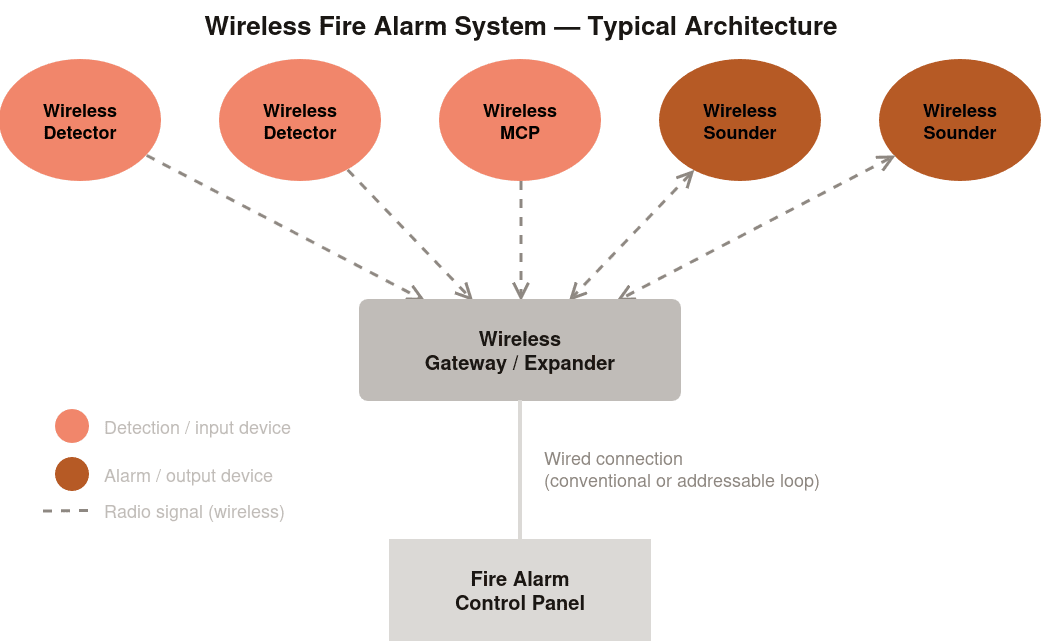
In a wireless fire alarm system, the detectors, call points, and sounders communicate with the control panel via a dedicated radio frequency rather than via hard-wired cables. Each device contains a radio transmitter and receiver and communicates with the panel on a frequency reserved for life safety systems, typically in the 868 MHz band in Europe.
Most modern wireless fire alarm systems use a mesh network topology, where each device can relay signals from other devices, providing multiple signal paths back to the panel. This significantly increases resilience — if one device or signal path fails, the system automatically routes signals via an alternative path.
| Characteristic | Detail |
|---|---|
| Communication frequency | Typically 868 MHz — a licence-free band reserved for short-range devices including safety systems |
| Network topology | Mesh network — devices relay signals from neighbours, providing resilient multi-path communication |
| Power source | Battery-powered devices — typically with a 2 to 5 year battery life depending on manufacturer and usage |
| Panel | Dedicated wireless-compatible control panel — or a wireless interface module connected to a conventional or addressable panel |
| Supervision | Devices poll the panel at regular intervals — typically every 10 to 60 seconds — so the system knows immediately if a device stops communicating |
| Standards | EN 54-25 (components using radio links) — compliant systems must meet the same detection and alarm performance standards as wired systems |
When to use
When Does a Wireless System Make Sense?
The primary advantage of a wireless system is the elimination or significant reduction of cable runs. This translates into real benefits in specific situations:
Listed or historic buildings
Where cable routes through original fabric, decorative ceilings, or listed features would be either prohibited or prohibitively expensive to make good afterwards. Wireless eliminates the need for cable containment and surface chasing entirely.
Occupied premises where disruption must be minimised
In offices, hotels, or retail premises that cannot close for installation, the absence of cable runs dramatically reduces disruption to occupants and the duration of the installation programme.
Buildings with difficult cable routes
Where the building layout makes wiring extremely complex or expensive — for example, premises spread across multiple buildings connected by open walkways, or buildings with solid concrete construction throughout.
Temporary or rapidly changing layouts
In premises where the layout changes frequently — exhibition spaces, temporary structures, or rapidly expanding businesses — wireless systems can be reconfigured without cable works.
Extending an existing wired system
Adding wireless devices to extend coverage into areas that would be difficult or expensive to reach with cable — plant rooms, outbuildings, or newly acquired adjacent spaces.
Reliability
Are Wireless Systems as Reliable as Wired?
Modern EN 54-25 compliant wireless fire alarm systems, from reputable manufacturers, are reliable and suitable for use in the majority of buildings. The mesh network topology means that a single device failure or radio interference event does not compromise the system. The continuous supervision polling means that any device that stops communicating is immediately flagged as a fault.
However, there are genuine considerations that do not apply to wired systems:
| Consideration | Detail |
|---|---|
| Battery management | Every wireless device is battery-powered and batteries must be replaced regularly — typically every 2 to 5 years. The panel will indicate low battery warnings, but these must be acted on promptly and recorded in the log book. |
| Radio interference | In environments with dense radio frequency activity — some industrial sites, near certain medical equipment, or in heavily shielded buildings — radio performance may be affected. A pre-installation radio survey is recommended in any environment where interference is a concern. |
| Shielding | Very thick reinforced concrete structures can attenuate radio signals significantly. Mesh devices help mitigate this but some buildings may not be suitable for wireless without supplementary repeaters. |
| Ongoing maintenance cost | Battery replacements add to the ongoing maintenance cost in a way that wired systems do not. This should be factored into whole-life cost comparisons. |
| Manufacturer dependency | Wireless devices are proprietary to a much greater degree than wired alternatives — replacing individual devices typically requires using the original manufacturer’s products. |
Cost
What Does a Wireless System Cost Compared to Wired?
Wireless fire alarm systems involve a different cost profile to wired installations — higher equipment costs offset by lower installation labour costs:
| Cost element | Wireless vs wired |
|---|---|
| Device cost | Typically 2 to 3 times higher per device than equivalent wired devices — the radio hardware adds significant cost |
| Installation labour | Significantly lower — no cable runs, containment, or chasing. In occupied or listed buildings the saving can be substantial. |
| Making good / decoration | Much lower or zero — a major cost saving in occupied or finished premises |
| Overall installed cost | Broadly comparable to addressable wired systems in most buildings. In listed or occupied buildings, wireless is frequently cheaper overall. |
| Ongoing maintenance | Higher than wired — battery replacements add cost over the system lifetime. Factor this into whole-life cost comparisons. |
Whole-life cost matters more than installation cost
When comparing wireless and wired systems, always consider the whole-life cost over the expected system lifetime — typically 10 to 15 years. Battery replacement costs over this period can be significant in a large wireless installation, and should be explicitly included in any cost comparison alongside the maintenance contract costs for both system types.