How fire alarm systems work
A complete end-to-end explanation of how a commercial fire alarm system works — from detection through to evacuation, ARC notification, and ancillary system control.
Most people know that a fire alarm makes a noise when there is a fire. Few understand the chain of events between a fire starting and the alarm sounding — or all the other things a modern fire alarm system does simultaneously. Understanding how the system works end to end helps building managers make better decisions about specification, maintenance, and response.
The Components of a Fire Alarm System
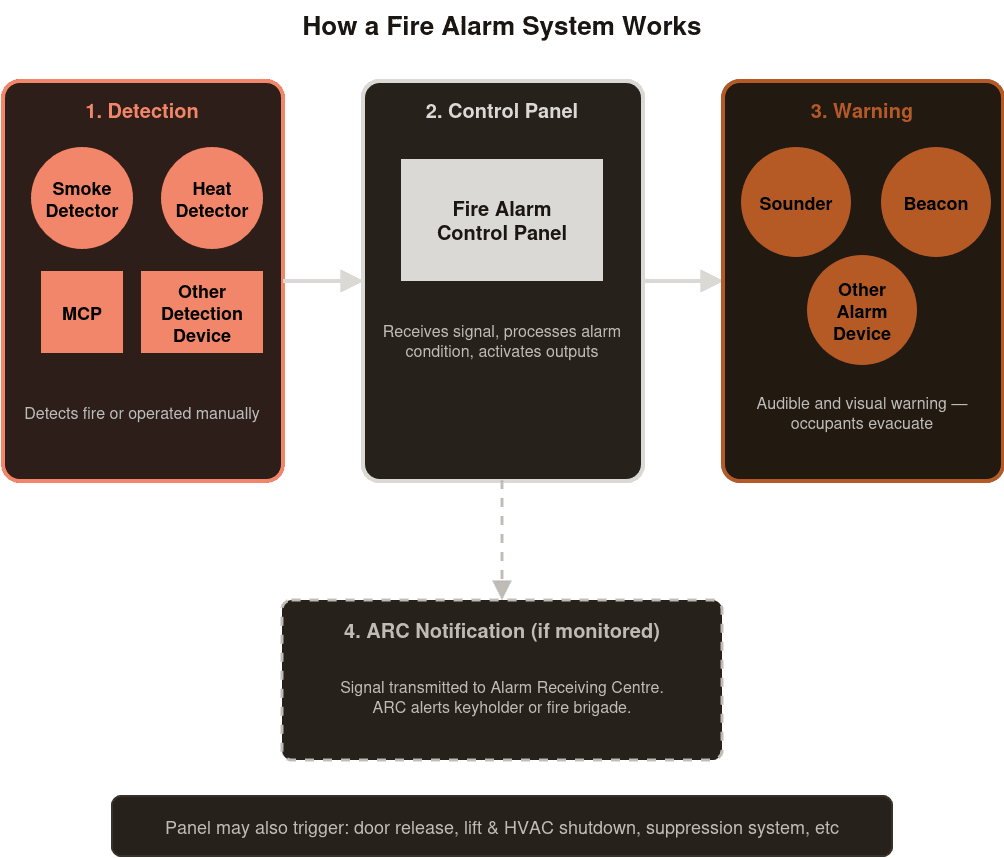
A commercial fire alarm system under BS 5839-1 consists of four main elements working together: detection, control, warning, and ancillary outputs. Each has a distinct role in the chain from fire starting to occupants evacuating safely.
Stage 1 — Detection
Detection — Identifying the Fire
Detection is the first stage. Automatic detectors — smoke detectors, heat detectors, or multi-sensor devices — continuously monitor the air in every room that falls within the system category. When conditions indicate a fire, the detector sends an alarm signal to the control panel.
The speed of detection depends on the detector type and the nature of the fire. A fast flaming fire in a room with a ceiling-mounted optical detector may trigger an alarm within seconds. A slow smouldering fire in a roof void may take minutes to produce sufficient smoke to reach and trigger a detector. The system designer specifies detector types and positions to give the earliest possible warning in each area — see our guide to detector spacing requirements for the rules that govern positioning.
If no automatic detection is present, the first stage of alarm is a person discovering the fire and operating a manual call point.
Stage 2 — Control panel
The Control Panel — Processing and Decision Making
The fire alarm control panel is the brain of the system. It receives signals from every device on the system, processes them, and activates the appropriate outputs based on its programmed cause and effect logic.
On a conventional panel, an alarm signal from any device on a zone circuit triggers the zone indicator and activates all programmed outputs for that zone. The panel cannot identify which individual device has activated — only which zone.
On an addressable panel, each device has a unique address and communicates its exact status. The panel displays the device description — room name, floor, and location — and activates only the outputs programmed for that specific device or group. Addressable panels can also enter an investigation mode, sounding a warning in a staffed area before the full alarm, giving trained staff a brief window to investigate before occupant evacuation begins.
The panel also monitors the entire system for faults — broken wires, failed devices, low battery voltage, mains supply failure. Any fault generates a visible and audible indication that must be investigated and recorded in the log book.
Stage 3 — Warning
Warning Devices — Alerting Occupants
The panel activates sounder circuits when an alarm condition is confirmed. Sounders produce the audible alarm tone that tells occupants to evacuate. BS 5839-1 specifies minimum sound levels — at least 65 dB(A) throughout the building, and 75 dB(A) at any bedhead in sleeping accommodation, with all intervening doors closed.
On large or complex buildings, different sounder zones may produce different tones for different alarm conditions — an alert tone in adjacent areas while an evacuation tone sounds in the alarm zone, for example, supporting phased evacuation procedures.
Visual alarm devices (VADs) — flashing beacons — are used alongside sounders where occupants may have hearing impairments or where background noise levels are high enough to compromise sounder audibility.
Stage 4 — Ancillary outputs
Ancillary Outputs — Controlling Building Systems
Simultaneously with the sounders activating, the panel triggers its programmed ancillary outputs. These vary by building but commonly include:
- Door release units — electromagnetic hold-open devices on fire doors release, allowing doors to close and maintain fire compartmentation
- Lift recall — lifts are recalled to the ground floor and taken out of service so occupants cannot inadvertently use them during evacuation
- Ventilation shutdown or smoke control — HVAC systems may shut down to prevent smoke spread, or switch to a smoke extract mode depending on the building’s smoke control strategy
- Suppression system activation — in premises protected by gaseous suppression or other automatic suppression, the fire alarm panel may initiate the suppression sequence following confirmation from multiple detectors
- Access control release — electronic locks on escape routes may be released to ensure free egress during evacuation
Stage 5 — ARC notification
Alarm Receiving Centre — Remote Monitoring and Response
If the system is monitored, the control panel transmits an alarm signal to an alarm receiving centre (ARC) via a digital communicator. The ARC receives the signal, identifies the site, and initiates the agreed response protocol — typically alerting a nominated keyholder and/or contacting the fire service.
ARC monitoring is particularly valuable for premises that are unoccupied for significant periods — unmanned warehouses, commercial properties outside business hours, or holiday accommodation. Without monitoring, a fire starting in an unoccupied building may develop significantly before the alarm is detected by a passer-by.
Keeping the system working
Maintenance — Ensuring the System Works When Needed
A fire alarm system that is never tested may appear to work but contain developing faults that will cause it to fail when called upon. BS 5839-1 requires a comprehensive maintenance regime — weekly call point tests by nominated staff, six-monthly professional servicing by a competent contractor, and a log book recording every test, fault, and service visit.
The most important maintenance tasks are the ones easiest to neglect: the weekly test that confirms the alarm sounds, the battery check that confirms standby power is adequate, and the service report review that ensures identified deficiencies are actually resolved.
Common questions
Frequently Asked Questions
Detection speed depends on the type of fire, the detector type, and the position of the detector relative to the fire. A fast flaming fire in a room with a ceiling-mounted optical smoke detector can trigger an alarm within 30 to 60 seconds of ignition. A slow smouldering fire in a large warehouse may take several minutes to produce sufficient smoke density to trigger detection. Detector placement according to BS 5839-1 spacing rules ensures that detection occurs as early as possible in every covered area.
The system switches automatically to its standby battery. BS 5839-1 requires the battery to maintain the system in full operation for at least 24 hours following mains failure, plus 30 minutes in full alarm. This ensures the system continues to function through a power outage caused by the fire itself — provided the battery is in good condition and has been maintained correctly. A degraded battery may provide significantly less standby capacity than specified.