Signal transmission
and alarm receiving centres
What an alarm receiving centre is, how fire alarm signals are transmitted to them, the different grades of transmission path, and what monitoring actually means in practice for your building.
Having a fire alarm that sounds in the building is not always enough. For premises where rapid fire service response is critical — or where the building may be unoccupied — transmission of the alarm signal to a continuously staffed alarm receiving centre provides an additional layer of protection.
Alarm Receiving Centres Explained
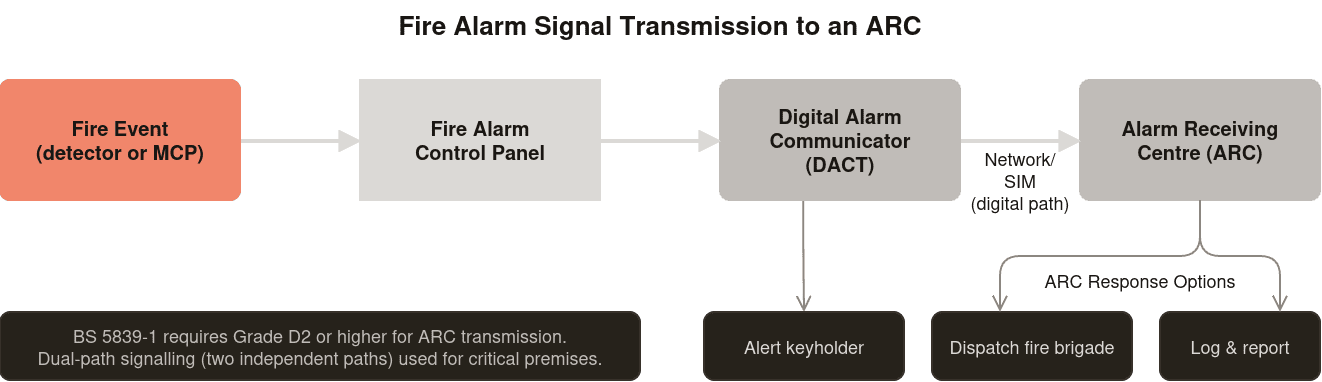
An Alarm Receiving Centre — ARC — is a continuously staffed facility that receives fire alarm signals from remote premises and takes appropriate action in response. When a fire alarm activates at a monitored premises, the signal is transmitted to the ARC, where operators verify the signal and, if appropriate, contact the building’s key holders or notify the Fire and Rescue Service.
ARCs are not the same as the fire service itself — the vast majority of ARCs are commercial organisations that provide monitoring services under contract. They operate to BS 5979 and are typically accredited by a third-party certification body such as NSI or SSAIB. ARC connection is relevant to Category P1 systems and to premises where insurers require monitored protection.
| What an ARC does | Detail |
|---|---|
| Receives alarm signals | 24 hours a day, 365 days a year — continuously staffed |
| Verifies signals | Attempts to contact the premises or key holders to verify whether the alarm is genuine before notifying the fire service — reducing unnecessary emergency responses |
| Notifies fire service | Contacts the Fire and Rescue Service if the alarm cannot be verified as a false alarm or if the alarm pattern indicates a genuine fire |
| Contacts key holders | Calls nominated key holders if the premises is unoccupied and a response is needed |
| Logs all events | Maintains a permanent record of all signals received, actions taken, and outcomes — useful evidence for insurers and the enforcing authority |
When carrying out the weekly fire alarm test, the ARC must always be notified before and after the test to prevent an unnecessary emergency response. This notification should be recorded in the fire alarm log book.
Transmission paths
How Signals are Transmitted to an ARC
The signal transmission path between the fire alarm panel and the ARC is as critical as the alarm system itself — a transmission path that fails in a fire is worse than no transmission at all. BS 8521 classifies transmission paths by their reliability and performance characteristics.
| Transmission method | How it works | Reliability |
|---|---|---|
| Digital Communicator (PSTN/ISTN) | Uses the public switched telephone network to transmit alarm signals — the traditional method using a dedicated telephone line | Moderate — dependent on telephone line availability. PSTN is being phased out across the UK. Existing PSTN-based systems will need upgrading. |
| IP/Broadband Transmission | Alarm signals transmitted over broadband internet connection — the primary method for new installations | Good — reliable for most premises. Vulnerable to broadband outages. Dual-path with a mobile backup is recommended for higher-risk premises. |
| Mobile Network (4G/5G) | Alarm signals transmitted via cellular mobile network — used as primary or backup transmission path | Good — independent of fixed-line infrastructure. Coverage dependent on mobile network strength at the premises. |
| Dual-Path Transmission | Two independent transmission paths used simultaneously or as primary and backup — typically IP broadband plus mobile network | High — failure of one path does not compromise the system. Recommended for higher-risk or high-value premises. |
| Dedicated Line (Grade 4) | Dedicated monitored circuit between the premises and the ARC — continuously supervised so any failure is immediately detected | Very high — the highest reliability transmission method. Reserved for the highest-risk applications. |
The PSTN switchover — act now if your system uses a telephone line
BT and other providers are switching off the traditional public switched telephone network (PSTN) and ISDN services across the UK, with completion targeted for 2027. Any fire alarm system currently transmitting signals via a dedicated telephone line will cease to function when the PSTN line is withdrawn. If your monitoring uses a telephone-based communicator, contact your maintenance contractor now to arrange an upgrade to IP or mobile transmission before your line is disconnected.
Transmission grades
BS 8521 Transmission Path Grades
BS 8521 classifies transmission paths into grades based on their resilience and supervision characteristics. The appropriate grade for a given premises is determined by the risk level and the consequences of a failed transmission.
| Grade | Description | Typical application |
|---|---|---|
| Grade 1 | Basic transmission — single path, limited supervision. Alarm only, no fault monitoring. | Low-risk premises where monitoring is desired but budget is limited |
| Grade 2 | Single supervised transmission path — faults on the transmission path are detected and reported | Standard commercial premises with moderate risk |
| Grade 3 | Dual supervised transmission paths — two independent paths, failure of one is immediately detected and reported | Higher-risk or higher-value premises where transmission resilience is important |
| Grade 4 | Dedicated continuously monitored circuit — the highest grade, any interruption is immediately detected | Highest-risk applications — critical infrastructure, very high-value premises |
Do you need monitoring?
Is ARC Monitoring a Legal Requirement?
ARC monitoring is not a universal legal requirement under the Fire Safety Order 2005 — the law requires an appropriate means of warning occupants, not necessarily remote monitoring. However, there are several situations where monitoring is effectively required or very strongly advisable:
Sleeping risk premises
Hotels, care homes, HMOs, and other premises where people sleep. Where occupants may not be able to self-evacuate or may be unaware of a fire, remote monitoring provides a critical additional layer of protection. Insurance requirements frequently mandate monitoring for these premises.
Premises unoccupied for periods
Where a building may be empty for extended periods — out of hours, at weekends, or during holiday periods — an unmonitored alarm that sounds only in the building provides no protection. This is why Category P1 systems almost always include ARC monitoring as part of the property protection strategy.
Insurance requirements
Many property insurers require ARC monitoring as a condition of cover, particularly for higher-value premises or premises with sleeping risk. Check your policy carefully — failure to comply with a monitoring requirement could invalidate your insurance.
Fire risk assessment recommendation
A fire risk assessment may recommend ARC monitoring as an appropriate control measure based on the specific risks and characteristics of your premises.
Costs
What Does ARC Monitoring Cost?
| Cost element | Typical range | Notes |
|---|---|---|
| ARC monitoring contract | £200–£600 per year | Varies by grade of transmission, ARC accreditation level, and response protocol |
| Transmission hardware | £150–£500 one-off | IP or dual-path communicator unit fitted to the fire alarm panel |
| Installation and commissioning | £100–£300 one-off | Configuration of the communicator and ARC account setup |
| Ongoing SIM or broadband costs | £50–£150 per year | If a dedicated mobile SIM is used for the transmission path |
Choosing an ARC
Always use an ARC that holds third-party certification to BS 5979 from NSI or SSAIB. Certification demonstrates that the ARC’s facilities, staffing, and procedures have been independently assessed. An uncertified ARC may not provide the response procedures or documentation your insurer expects.