False alarm management
in fire alarm systems
Why false alarms happen, the serious consequences of persistent unwanted alarms, and what can be done technically and procedurally to reduce them without compromising safety.
Unwanted fire alarm activations are one of the biggest practical challenges in fire alarm management. They disrupt businesses, erode occupant confidence in the alarm system, and place an unnecessary burden on the Fire and Rescue Service — which may now charge for repeated responses. For building managers dealing with a persistent problem, our practical guide to why alarms keep going off covers the most common causes and immediate fixes.
How Significant is the False Alarm Problem?
Unwanted fire alarm activations account for the vast majority of fire alarm activations attended by the Fire and Rescue Service in the UK. The National Fire Chiefs Council has consistently reported that well over 95% of automatic fire alarm actuations attended by fire services are not genuine fires.
The consequences of persistent unwanted alarms extend well beyond inconvenience. Occupants who have experienced repeated false alarms become desensitised and may delay evacuating — or fail to evacuate at all — when a genuine fire alarm sounds. This evacuation fatigue is a genuine safety risk that has contributed to fatalities in real fires.
| Consequence | Detail |
|---|---|
| Fire service charging | Many Fire and Rescue Services now charge for repeat attendance at premises with persistent false alarms. Charges vary by service but can be substantial — typically £250–£500 per attendance after an initial warning period. |
| Evacuation fatigue | Occupants who experience frequent false alarms become less likely to evacuate promptly — a serious safety risk in the event of a genuine fire |
| Business disruption | Each evacuation costs time and money. In a manufacturing, retail, or hospitality environment, repeated evacuations have a direct and measurable financial impact. |
| Reputational damage | Repeated alarms in hotels, schools, or public buildings cause reputational damage that can be difficult to recover from |
| Insurer action | Some insurers will increase premiums or withdraw cover from premises with a persistent false alarm problem |
Causes
What Causes Unwanted Alarm Activations?
| Cause category | Common examples |
|---|---|
| Cooking fumes | Smoke or steam from kitchens reaching detectors in adjacent areas — the most common cause in commercial premises. Often results from detectors of the wrong type. A heat detector rather than a smoke detector is the solution for kitchen environments. |
| Dust and aerosols | Dust from building works, aerosol sprays, cleaning products, or industrial processes activating smoke detectors. See our detector positioning guide for unsuitable environments. |
| Steam and condensation | Steam from showers, dishwashers, or industrial processes. Condensation in cold environments. Smoke detectors installed too close to steam sources. |
| Insects in detectors | Small insects entering detector chambers and causing spurious activations — more common in older detectors with less effective insect screening |
| Detector at end of life | BS 5839-1 recommends replacement at 10 to 12 years — older detectors should be considered a false alarm risk and flagged at service visits |
| Malicious or accidental call point activation | Manual call points activated by accident, by mischief, or deliberately. Glass-fronted call points with a higher activation barrier can reduce accidental and malicious activations. |
| Incorrect detector type | The wrong detector type specified for the environment — the most common and most easily resolved cause |
| System faults | Wiring faults, detector head faults, or panel faults generating spurious alarm signals. These should be identified and resolved during routine servicing. |
Solutions
What Can Be Done to Reduce False Alarms?
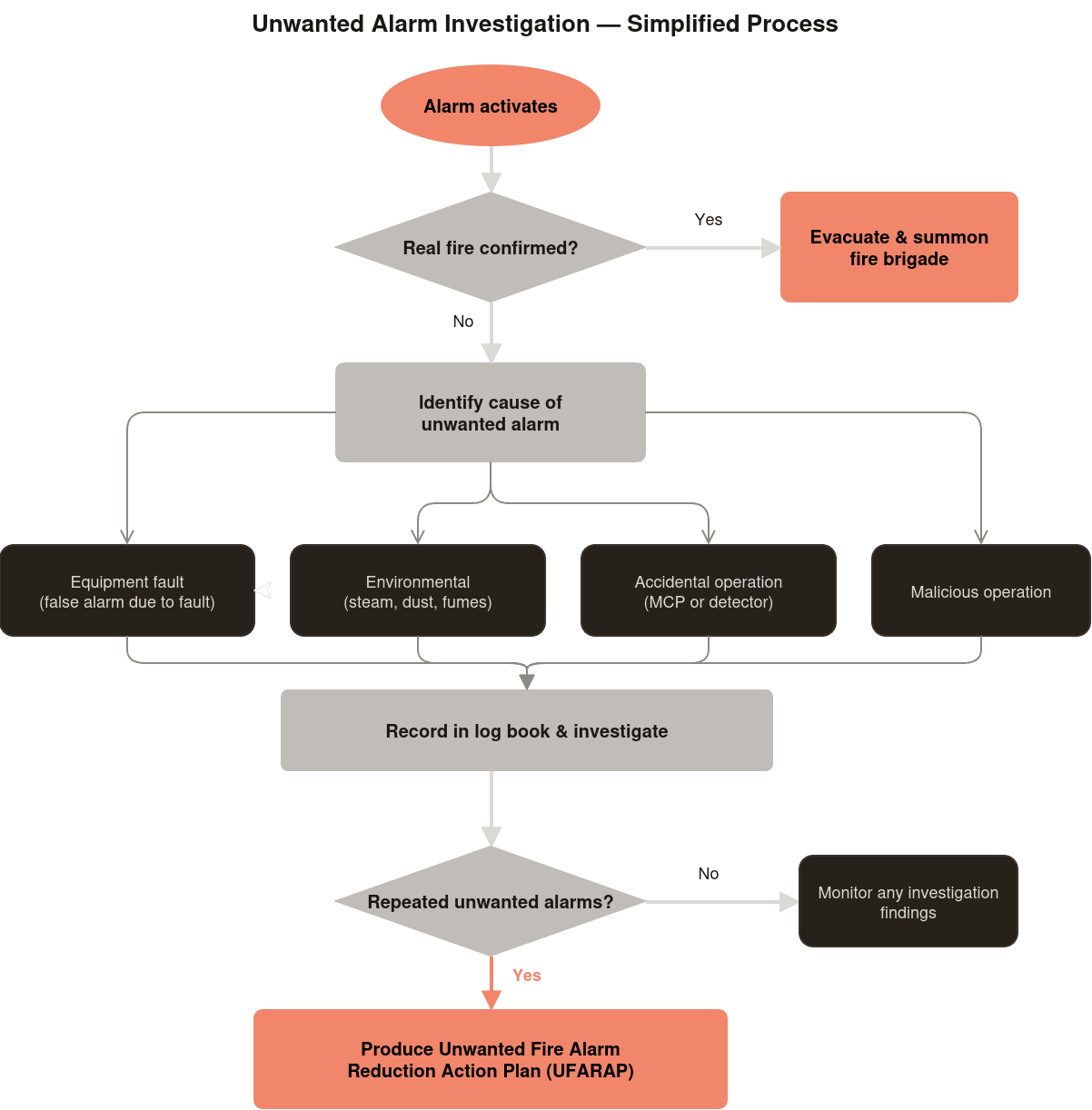
False alarm reduction requires a systematic approach — identifying the root cause of each unwanted activation and implementing an appropriate technical or procedural solution.
Detector selection and positioning review
The most effective long-term solution in many cases. Replace detectors of the wrong type with appropriate alternatives — multi-sensor detectors in areas prone to dust or cooking fumes, heat detectors in kitchens, beam detectors in areas with high airflow. Relocate detectors that are too close to steam or cooking sources in line with BS 5839-1 spacing guidance.
Coincidence detection
Programme the addressable panel to require two detectors to activate before sounding a full alarm. Only appropriate on addressable systems and must be documented in the cause and effect matrix.
Time-based sensitivity adjustment
On addressable systems, individual detector sensitivity can be adjusted automatically at different times of day. This requires careful programming and documentation.
Investigation mode / alarm confirmation
The panel is programmed to sound only an alert tone in the affected zone on the first activation, giving staff time to investigate before a full evacuation alarm sounds. Requires a documented investigation procedure and trained staff.
Detector replacement
Replace detectors that are at or beyond their recommended service life — typically 10 to 12 years. Ageing detector chambers become contaminated and unstable over time, significantly increasing false alarm risk. Your service report should flag detectors approaching end of life.
Staff training and procedures
Ensure all staff understand the investigation procedure when an alarm activates. Clear, documented procedures and regular training reduce both unnecessary evacuations and the risk of delayed response to a genuine fire.
False alarm log and root cause analysis
Record every unwanted activation in the fire alarm log book — when it occurred, which device activated, the probable cause, and what action was taken. Reviewing the log over time reveals patterns and identifies persistent problem zones.
False alarm reduction must not compromise safety
Every false alarm reduction measure carries a potential trade-off in detection speed or sensitivity. Coincidence detection, investigation modes, and sensitivity adjustments must be carefully designed and documented. The goal is to reduce unwanted alarms without creating a system that responds slowly or inadequately to a genuine fire. Any changes to the system’s cause and effect programming must be made by a competent engineer and documented in the as-installed records.