Fire alarm detector spacing
requirements
The BS 5839-1 rules for maximum detector spacing and wall distances for smoke and heat detectors — including how ceiling height and room geometry affect coverage calculations.
Detector spacing is one of the most precisely defined aspects of fire alarm design. BS 5839-1 sets out maximum distances between detectors and maximum distances from walls — figures that are based on the detection radius of each detector type and the rate at which smoke or heat spreads across a ceiling. Getting these figures wrong means detectors that meet the specification on paper but leave gaps in coverage where a fire could develop undetected.
BS 5839-1 Spacing Requirements
BS 5839-1 bases detector spacing on the concept of a coverage radius — the maximum horizontal distance from a detector within which it can reliably detect fire under the conditions assumed by the standard. The coverage radius determines both the maximum distance between detectors and the maximum distance from a wall or partition.
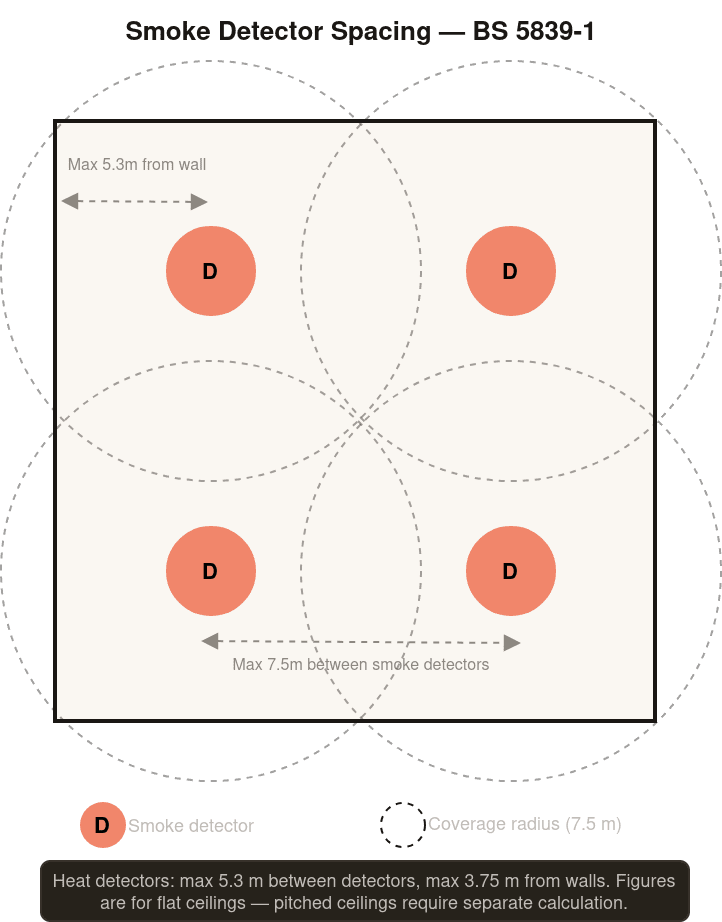
| Detector type | Max distance between detectors | Max distance from wall | Coverage radius |
|---|---|---|---|
| Smoke detector (optical or ionisation) | 7.5 m | 5.3 m | 7.5 m |
| Heat detector | 5.3 m | 3.75 m | 5.3 m |
| Multi-sensor detector (with heat element) | 5.3 m | 3.75 m | 5.3 m |
These figures apply to flat ceilings at or below 6m in height. Different rules apply for higher ceilings, pitched roofs, and beam or truss constructions — see below.
How the figures are derived
Understanding Coverage Radius
The coverage radius figures in BS 5839-1 are derived from the assumption that smoke or hot gases spread outward from a fire across the ceiling before descending. The detector must be close enough to the fire origin to receive sufficient smoke or heat before the alarm threshold is reached.
The maximum distance between two detectors — 7.5m for smoke, 5.3m for heat — means that any point on the floor directly below the ceiling is within the coverage radius of at least one detector. The wall distance is smaller (5.3m and 3.75m respectively) because a wall creates a boundary that interrupts the spreading smoke layer, requiring the detector to be closer to the wall to provide equivalent coverage.
Ceiling height and adjustments
How Ceiling Height Affects Spacing
The standard spacing figures assume a ceiling height of no more than 6m. For higher ceilings, the spacing rules change significantly:
| Ceiling height | Smoke detector adjustment | Notes |
|---|---|---|
| Up to 6 m | Standard spacing applies (7.5 m / 5.3 m from wall) | Most commercial buildings |
| 6 m to 9 m | Reduce spacing — consult manufacturer’s data | Smoke dilutes more before reaching detector; spacing must be reduced |
| Over 9 m | Standard point detectors may be unsuitable — beam detectors or aspirating systems should be considered | Warehouses, atria, sports halls |
| Pitched roof up to 45° | Detectors placed at the apex; additional detectors at lower levels may be needed | Smoke rises to apex — first detector at peak, then standard spacing below |
Obstructions and beams
Dealing With Beams and Obstructions
Structural beams, downstand beams, and ceiling obstructions can significantly affect smoke movement and detector coverage. BS 5839-1 treats a beam as a barrier to smoke movement if it projects more than 10% of the ceiling height below the ceiling level. In such cases, each bay between beams may need to be treated as a separate compartment for detector spacing purposes — meaning additional detectors.
Obstructions such as high racking, large ductwork, or ceiling-mounted equipment must also be considered. A detector mounted in a position where its coverage is blocked by a physical obstruction provides no protection in the area behind that obstruction. The designer must ensure line-of-sight coverage or add detectors to cover the obscured area.
Detector positioning on the ceiling
Where on the Ceiling Should Detectors Be Mounted?
BS 5839-1 requires detectors to be mounted on the ceiling where possible. Specific positioning rules include:
- Detectors should be mounted at least 500mm from any wall or partition (to avoid dead air zones at room junctions)
- Detectors should not be mounted within 500mm of a light fitting or other heat source that could affect sensitivity
- In rooms with sloping ceilings, the first detector should be placed within 600mm of the highest point
- Detectors should not be mounted in air streams from ventilation outlets — air movement can dilute smoke before it reaches the detector
- On exposed trussed roofs, detectors should be placed at the apex of each bay as well as at lower levels
Common questions
Frequently Asked Questions
Yes — the spacing rules apply to all rooms that require detection under the system category. For very small rooms (under about 10m²), a single centrally-positioned detector will satisfy the spacing requirements. For larger rooms, multiple detectors are needed. The geometry of the room — its length, width, and shape — determines the minimum number of detectors required to achieve full coverage without exceeding the maximum spacing.
Heat detectors respond to temperature rather than smoke particles. Heat disperses and dilutes more quickly than smoke as it spreads from a fire, so the effective detection radius of a heat detector is smaller than that of a smoke detector. The smaller spacing figures for heat detectors — 5.3m between detectors, 3.75m from walls — reflect this reduced detection radius.
BS 5839-1 permits the use of manufacturer’s data where it is based on recognised test methods and gives equivalent or better protection than the standard spacing figures. In practice, most manufacturers’ data for standard point detectors aligns closely with the BS 5839-1 figures. For specialist detectors — beam detectors, aspirating systems, or detectors for very high ceilings — manufacturer’s data is essential because the standard figures do not apply.