Fire detection devices
explained
A plain-English guide to the different types of fire detector available in the UK — how each one works, what it detects, and where it should and should not be used.
Choosing the right detector for the right environment is one of the most important decisions in fire alarm design. The wrong choice leads either to missed fires or to a system plagued by false alarms — neither of which is acceptable.
Why Detector Type Matters
Different fires produce different products of combustion. A smouldering upholstery fire produces large quantities of smoke particles at an early stage. A fast-flaming liquid fire may produce relatively little visible smoke but intense heat. A fire involving electrical equipment may produce invisible combustion gases long before visible smoke or heat is apparent.
No single detector type is optimal for every environment. BS 5839-1 requires that the choice of detector is appropriate to the hazard, the environment, and the consequences of both a missed detection and an unwanted alarm. The system category determines which areas require detection — the detector type selected for each area determines how reliably that detection performs.
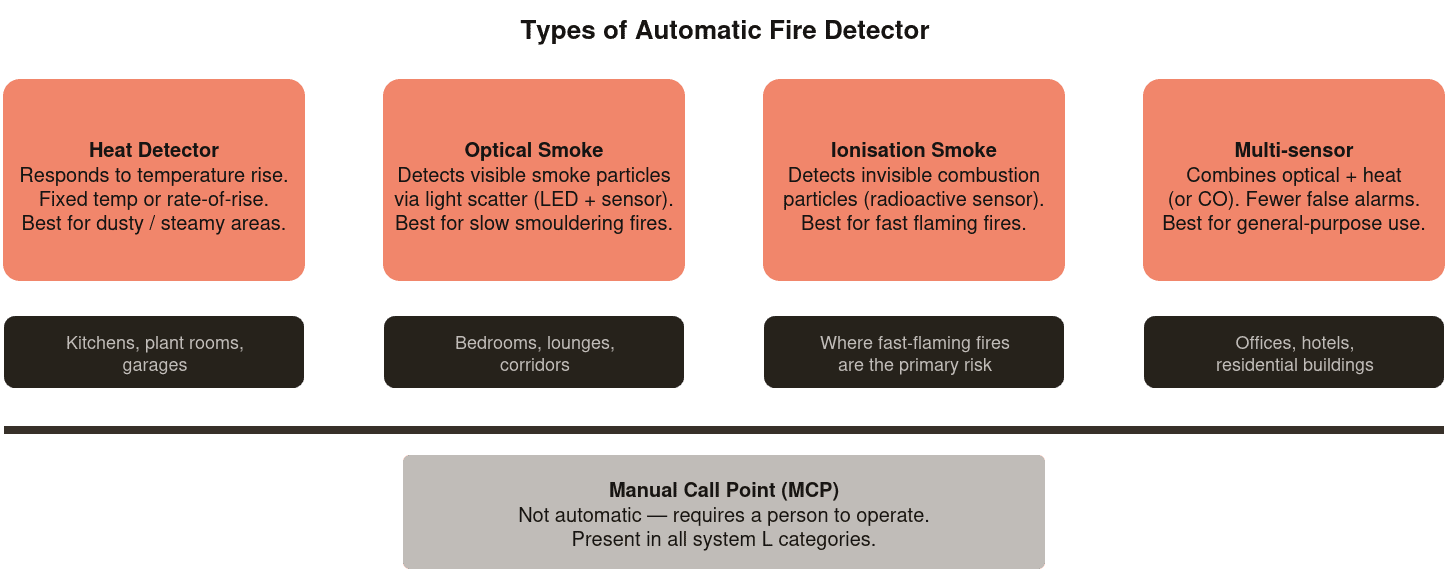
Smoke detection
Optical Smoke Detectors
How they work
Optical detectors — also called photoelectric detectors — use an infrared LED light source and a photosensitive receiver arranged at an angle to each other inside the detector chamber. In normal conditions the light beam does not reach the receiver. When smoke particles enter the chamber they scatter the light, some of which reaches the receiver and triggers the alarm.
| Characteristic | Detail |
|---|---|
| Best at detecting | Slow-burning, smouldering fires producing large visible smoke particles — upholstery, foam, paper, wood |
| Less sensitive to | Fast-flaming fires with small combustion particles; clean-burning fires with little visible smoke |
| Typical applications | Offices, hotel bedrooms, hospital wards, residential premises, escape routes |
| Avoid in | Kitchens, dusty or steamy environments, areas with high airflow — prone to false alarms from cooking fumes, steam, and dust |
| Standard | EN 54-7 |
Optical detectors are the most widely installed detector type in the UK and are generally the default choice for most standard commercial and residential applications. For a detailed comparison of optical and heat detectors and where each belongs, see our guide to smoke detectors vs heat detectors.
Ionisation Smoke Detectors
How they work
Ionisation detectors contain a small amount of a mildly radioactive material — typically Americium-241 — which ionises the air between two electrically charged plates inside the detector chamber, creating a small constant current. When smoke enters, the particles attach to the ions and reduce this current, triggering the alarm.
| Characteristic | Detail |
|---|---|
| Best at detecting | Fast-flaming fires producing small invisible combustion particles — spirit fires, some solvent fires |
| Less sensitive to | Slow smouldering fires producing large visible smoke particles |
| Typical applications | Historically used widely — now less commonly specified due to disposal regulations and the performance advantages of optical and multi-sensor detectors |
| Avoid in | Dusty environments, areas near cooking — prone to unwanted alarms. Note: disposal is regulated due to radioactive content |
| Standard | EN 54-7 |
Ionisation detectors are now relatively rarely specified for new installations in the UK. Multi-sensor detectors offer superior performance across a wider range of fire types and are generally preferred where a combination of sensitivity is required.
Heat detection
Heat Detectors — Fixed Temperature and Rate-of-Rise
How they work
Heat detectors respond to the temperature of the air around them rather than to combustion products. Fixed temperature detectors trigger when the air temperature reaches a set threshold — typically 57°C or 83°C. Rate-of-rise detectors trigger when the temperature rises faster than a set threshold — typically more than 8°C per minute — regardless of the absolute temperature. Many modern heat detectors combine both functions.
| Characteristic | Detail |
|---|---|
| Best at detecting | Fires in environments where smoke detectors would produce unwanted alarms — kitchens, boiler rooms, dusty workshops |
| Limitation | Slower to respond than smoke detectors — heat detectors are a late-stage indicator. Not appropriate where early warning is essential. |
| Typical applications | Commercial kitchens, plant rooms, garages, storage areas, areas with high dust or steam levels |
| Avoid using as sole detection in | Sleeping risk areas, escape routes, or any area where early warning is critical to safe evacuation |
| Standard | EN 54-5 |
Heat detectors are a valuable tool in the right environment but should never be seen as a direct substitute for smoke detection where early warning is the priority. The spacing requirements for heat detectors under BS 5839-1 are tighter than for smoke detectors — 5.3m between devices and 3.75m from walls.
Multi-Sensor Detectors
How they work
Multi-sensor detectors combine optical smoke sensing with heat sensing in a single unit. The detector’s on-board processor analyses the signals from both sensors simultaneously and uses an algorithm to decide whether the combination of readings is consistent with a genuine fire. This approach significantly reduces false alarm rates compared to single-sensor detectors while maintaining high sensitivity to genuine fires.
| Characteristic | Detail |
|---|---|
| Best at detecting | A wide range of fire types — both smouldering and flaming fires |
| Key advantage | Significantly lower false alarm rate than optical-only detectors — particularly in environments with intermittent dust, steam, or cooking fumes |
| Typical applications | Areas requiring high sensitivity with low false alarm risk — server rooms, hotels, commercial kitchens with adjacent areas, general office environments |
| Standard | EN 54-29 (multi-sensor) or EN 54-7/EN 54-5 combined |
Multi-sensor detectors have become increasingly popular in commercial installations and represent current best practice for most standard applications where a balance of sensitivity and false alarm immunity is required. See our guide to where smoke detectors should be installed for positioning guidance across different room types.
Carbon Monoxide Detectors
How they work
CO fire detectors — distinct from domestic CO alarms — use an electrochemical cell that reacts with carbon monoxide gas and produces a small electrical current proportional to the CO concentration. They are designed to detect the invisible CO produced in the early stages of many fires, before visible smoke is present.
| Characteristic | Detail |
|---|---|
| Best at detecting | Smouldering fires and fires involving incomplete combustion — particularly in well-sealed or high-value environments |
| Key advantage | Extremely resistant to false alarms from dust, steam, and aerosols — providing reliable early warning where optical detectors struggle |
| Typical applications | Often used in combination with optical detectors in multi-sensor configurations; also used in sleeping risk premises and areas where aerosol false alarms are a concern |
| Note | Not a substitute for domestic CO alarms — these are separate products with different standards and purposes |
| Standard | EN 54-26 |
Specialist detection
Beam Detectors
How they work
Optical beam detectors project an infrared beam across a large open space — typically between 5 and 100 metres — from a transmitter to a reflector and back to a combined transmitter/receiver unit. When smoke accumulates in the beam path it reduces the intensity of the received signal. When the reduction exceeds a set threshold the alarm is triggered.
| Characteristic | Detail |
|---|---|
| Best at detecting | Smoke in large open spaces with high ceilings where point detectors would be impractical or insufficient |
| Key advantage | A single beam detector can protect a large area that would require many point detectors — significant cost saving in warehouses, atria, and industrial buildings |
| Typical applications | Warehouses, distribution centres, sports halls, aircraft hangars, large atria, historic buildings where ceiling access is difficult |
| Maintenance consideration | Requires periodic alignment checks and cleaning of reflector and lens — misalignment can cause spurious alarms or reduced sensitivity |
| Standard | EN 54-12 |
Aspirating Smoke Detection — ASD and VESDA
How they work
Aspirating smoke detection systems actively draw air samples through a network of pipes — fitted with small sampling holes — back to a central detection unit where the air is analysed using a highly sensitive laser-based detector. This allows detection at extremely low smoke concentrations — far earlier than conventional point detectors. VESDA is a widely recognised brand name that has become a generic term for high-sensitivity aspirating systems.
| Characteristic | Detail |
|---|---|
| Sensitivity | Can detect smoke at concentrations many times lower than conventional detectors — providing very early warning, often before a fire is visible |
| Key advantage | Earliest possible warning; ideal for high-value or critical environments where early intervention prevents catastrophic loss |
| Typical applications | Data centres, server rooms, telecommunications facilities, museums, archives, clean rooms, historic buildings |
| Cost | Significantly more expensive than point detection — both to install and maintain. Justified only where the consequence of a late-detected fire is severe. |
| Standard | EN 54-20 |
Aspirating detection is one of the specialist fire alarm system types used where conventional point detectors cannot provide the required sensitivity or response speed.
Flame Detectors
How they work
Flame detectors respond to the electromagnetic radiation emitted by a flame — typically in the ultraviolet (UV), infrared (IR), or combined UV/IR spectrum. They detect the characteristic flicker frequency of a flame rather than smoke or heat, making them ideal for environments where fires are likely to be fast and flaming with little preliminary smoke.
| Characteristic | Detail |
|---|---|
| Best at detecting | Fast-flaming fires — particularly those involving flammable liquids, gases, or materials that burn cleanly with little smoke |
| Key advantage | Extremely fast response to open flame — can trigger suppression systems in seconds |
| Typical applications | Petrochemical facilities, fuel storage areas, aircraft hangars, paint spray booths, areas storing flammable liquids |
| Limitation | Line-of-sight devices — cannot detect fires that are obscured. Some UV types susceptible to false alarms from arc welding and lightning. |
| Standard | EN 54-10 |
Linear Heat Detection
How they work
Linear heat detectors — sometimes called heat-sensitive cable — are a continuous length of heat-sensing cable that can be run along cable trays, conveyor belts, roof voids, or any other linear route. When any point along the cable reaches the trigger temperature, an alarm is generated. Some types can also pinpoint the location along the cable where the heat has been detected.
| Characteristic | Detail |
|---|---|
| Best at detecting | Heat along extended linear routes — cable trays, conveyor belts, tunnels, roof voids |
| Key advantage | Provides continuous protection along the entire route — no gaps in coverage as with point detectors |
| Typical applications | Cable tunnels and trenches, conveyor systems, cold storage facilities, long tunnels, escalators, areas where point detectors cannot be installed |
| Types | Fixed temperature (triggers once, must be replaced) or resettable (can be reset after the heat source is removed) |
| Standard | EN 54-22 |