Grades of fire alarm system — A to F explained
What the BS 5839 grade system means, how grades A to F differ, and which grade is appropriate for different premises — explained by a fire engineer with 30 years of experience.
The grade of a fire alarm system describes the type of equipment used — specifically, the nature of the control function and the power supply. While the category tells you where detection is installed, the grade tells you what kind of system it is. Grade and category together fully define a BS 5839 fire alarm system.
What Grade Means in BS 5839
Every fire alarm system under BS 5839 is defined by two characteristics: its category and its grade. The category (L1–L5, P1–P2, or M) defines the purpose and coverage of the system. The grade defines the type of equipment.
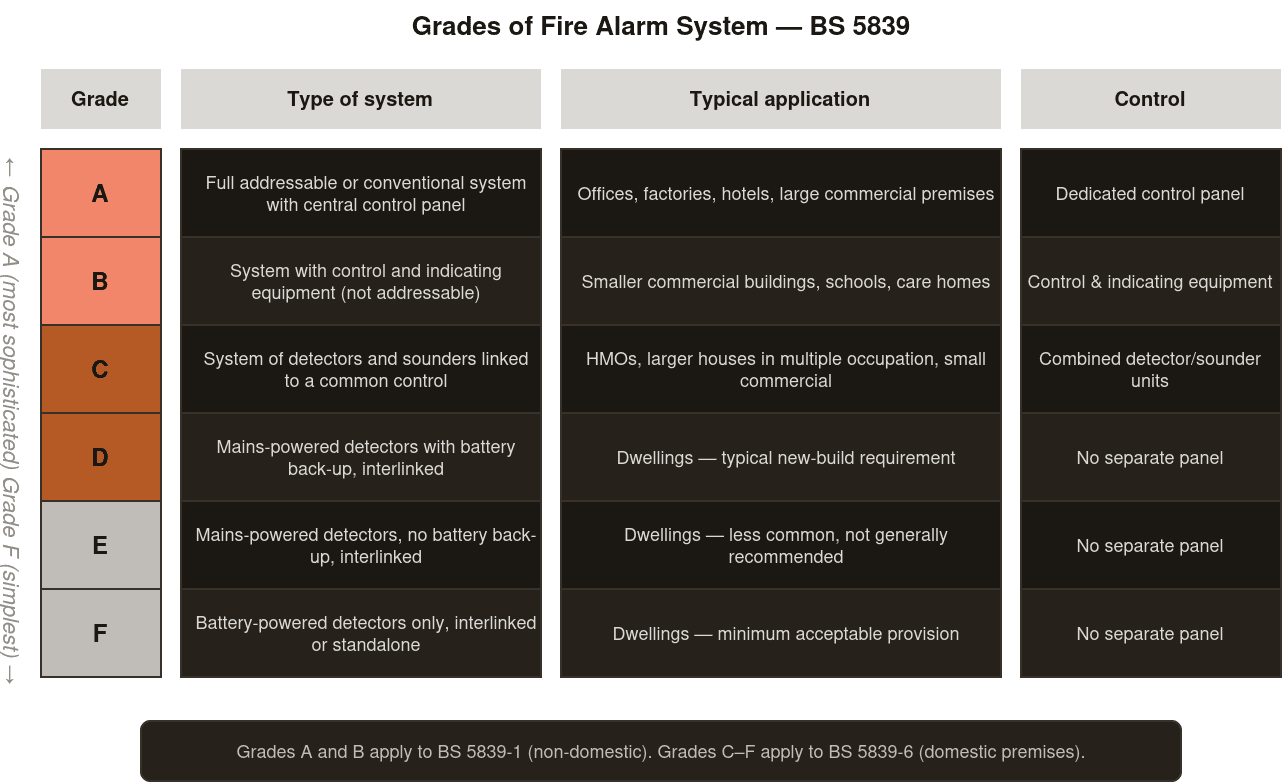
Grades A and B appear in BS 5839-1 and apply to non-domestic premises. Grades C through F appear in BS 5839-6 and apply to domestic premises. A Grade A/L2 system, for example, is a full panel-based non-domestic system providing escape route and high-risk area coverage. A Grade D/LD2 system is a mains-powered domestic system covering escape routes and high-risk rooms.
Non-domestic grades
Grades A and B — Non-Domestic Premises
For non-domestic premises under BS 5839-1, two grades are defined:
| Grade | Equipment type | Typical application |
|---|---|---|
| Grade A | A fire alarm system comprising fire detectors, manual call points, sounders, and a dedicated fire alarm control panel with its own power supply and standby battery | The standard specification for commercial and industrial premises — offices, factories, hotels, schools, care homes. The vast majority of non-domestic fire alarm systems are Grade A |
| Grade B | A system using control and indicating equipment (CIE) that is not a full dedicated fire alarm panel — for example, a combined intruder/fire system or a simple zone indicator panel | Less common in modern installations — may be encountered in smaller or simpler premises where a full Grade A panel is considered disproportionate. BS 5839-1 does not recommend Grade B for new installations in most circumstances |
In practice, virtually all new commercial fire alarm installations in the UK are Grade A. Grade B is mainly encountered in legacy systems.
Domestic grades
Grades C to F — Domestic Premises
For domestic premises under BS 5839-6, four grades are defined, reflecting the range from simple battery smoke alarms to panel-based systems:
| Grade | Equipment type | Power supply | Typical application |
|---|---|---|---|
| Grade C | System of detectors and sounders controlled by a central panel | Mains with standby battery | Larger HMOs, sheltered housing, higher-risk dwellings requiring a panel-based system |
| Grade D | Mains-powered detectors with integral battery backup, interlinked | Mains with battery backup in each unit | Standard for new-build houses and flats — required by Building Regulations for most new dwellings |
| Grade E | Mains-powered detectors without battery backup, interlinked | Mains only — no backup | Not generally recommended — power failure leaves system inactive. Rarely specified for new installations |
| Grade F | Battery-powered detectors, interlinked or standalone | Battery only | Minimum acceptable provision under BS 5839-6 — acceptable for existing dwellings where mains power is not practicable |
Grade and category together
How Grade and Category Are Used Together
A complete BS 5839 system specification always states both grade and category. The combination tells you everything about the system type and coverage:
- Grade A / Category L2 — a full panel-based non-domestic system covering escape routes and high-risk areas
- Grade A / Category P1 — a full panel-based non-domestic system providing whole-building property protection
- Grade D / Category LD2 — mains-powered interlinked domestic detectors covering escape routes and high-risk rooms
- Grade C / Category LD1 — panel-based domestic system covering the entire dwelling
Common questions
Frequently Asked Questions
Virtually all office fire alarm systems in the UK are Grade A — a dedicated control panel with zone indicators or an addressable display, wired to detectors and call points throughout the building, with a standby battery providing at least 24 hours backup power followed by 30 minutes in alarm. The category will depend on the fire risk assessment — typically L2 or L3 for most office buildings.
It depends on the size and type of HMO. For smaller HMOs — three or four occupants in a house — a Grade D, Category LD2 system with mains-powered interlinked detectors covering escape routes and principal rooms is typically sufficient. For larger HMOs, or those with more than one floor and multiple bedsitting rooms, a Grade C panel-based system may be required. The local authority licensing conditions will specify what is needed for a licensed HMO.
Grade F (battery-only) detectors are the minimum acceptable provision under BS 5839-6 and may be used in existing dwellings where running mains cable is not practicable. However, for rented properties, landlords should be aware that a Grade F system may not satisfy local authority HMO licensing requirements or insurance conditions, which will typically require mains-powered Grade D as a minimum. Battery detectors also require regular battery replacement and testing to remain effective.