Fire alarm zoning explained
What a fire alarm zone is, the BS 5839-1 rules on zone size and boundaries, and why correct zoning is fundamental to locating a fire quickly when the alarm activates.
Zoning is the way a fire alarm system divides a building into manageable sections so that when an alarm activates, the control panel can indicate which part of the building the alarm has come from. Without correct zoning, a building could have dozens of detectors all reporting to the panel as a single unnamed area — making it impossible to locate the fire quickly and efficiently.
Fire Alarm Zones — the Basic Concept
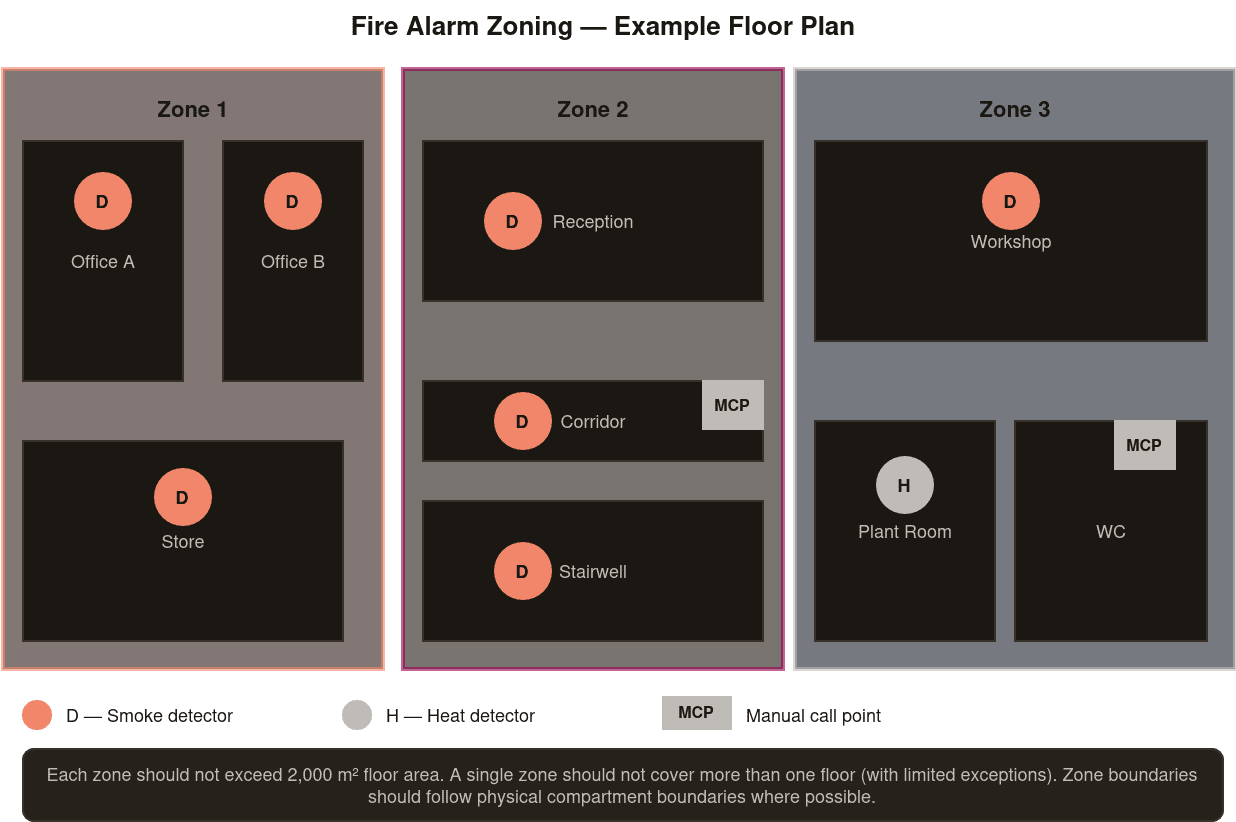
A zone is a defined area of a building covered by a group of fire detectors and/or manual call points connected to the same circuit. When any device in the zone activates, the control panel displays an alarm for that zone — identifying which part of the building to investigate.
On a conventional system, the zone is all the information the panel provides — it cannot identify which individual detector has activated, only which zone. On an addressable system, the panel can identify the exact device, but zones are still used to organise the system logically and to define the area that a responding person should search.
The BS 5839-1 rules
Zone Size and Boundary Rules
BS 5839-1 sets specific limits on zone size and boundary placement to ensure zones are small enough to be searchable quickly and aligned logically with the building’s physical structure.
| Rule | Requirement | Reason |
|---|---|---|
| Maximum zone floor area | 2,000 m² | A zone larger than 2,000m² takes too long to search — the responding person cannot locate the fire quickly enough to take effective action |
| Single floor per zone | Each zone should cover only one floor of the building | A zone spanning multiple floors forces the responder to search several floors — significantly delaying fire location |
| Zone boundaries | Should follow fire compartment boundaries where possible | Compartment walls limit fire spread; aligning zones with compartments makes the panel indication more useful for fire service response |
| Search distance within a zone | Any point within the zone should be reachable within approximately 30 seconds of entering the zone | The zone should be small and simple enough to investigate quickly — an oddly shaped or elongated zone may satisfy the area limit but still be difficult to search |
| Stairwells and shafts | Vertical elements such as stairwells may be treated as a single zone throughout their height | A stairwell is a single vertical space — a detector anywhere in it indicates a risk to the escape route, and the specific floor is less critical than the fact that the stairwell is affected |
Zones in practice
How Zones Are Applied in Real Buildings
In a simple single-storey building of under 2,000m², a single zone covering the whole building may be sufficient. In a multi-storey building, each floor will typically have at least one zone, and larger floors may be divided into two or more zones along compartment boundaries.
In a typical office building, the ground floor might be Zone 1 (reception, meeting rooms, office area), the first floor Zone 2 (open-plan office), with the plant room and service areas forming Zone 3. Each zone is clearly identified on the control panel and on the zone plan displayed beside it.
The number of zones is also limited by the capacity of the control panel. A conventional panel has a fixed number of zone inputs — typically between 2 and 20 depending on the panel model. An addressable panel can handle far more zones, and the zone configuration can usually be changed through the programming without rewiring.
Common questions
Frequently Asked Questions
BS 5839-1 recommends that each zone covers only one floor. However, the standard does permit a single zone to cover more than one floor where the total floor area of the zone does not exceed 300m² and the building is not more than three storeys. In practice this exception applies to small buildings — a two-storey office of 200m² per floor, for example — where a single zone for the whole building is reasonable. For most multi-storey commercial buildings, separate zones per floor is the correct approach.
Yes — BS 5839-1 recommends that each zone includes at least one manual call point positioned so that occupants can raise the alarm manually regardless of whether automatic detection has activated. In practice, call points are positioned on escape routes within each zone, ensuring that any person discovering a fire can trigger the alarm from within the zone where the fire is located.
A zone that is too large requires the responding person to search a much larger area to locate the fire — losing precious time. In a large building where evacuation may be phased, the fire service needs to know quickly and precisely which part of the building is affected. Poorly zoned systems have contributed to delayed fire service response and difficulty in confirming evacuation in real incidents. It is one of the most commonly cited deficiencies in fire alarm system audits.